The lab’s work is built on process-based ecosystem models. We develop new process representations, test them against field and laboratory data, and release the analysis code behind our papers.
McGill Wetland Model (MWM)
A process-based model of peatland carbon and nutrient cycling. Our contributions added peat cohort tracking, microbial controls on decomposition, and an explicit ericoid mycorrhizal fungal pool coupled to shrub nutrient demand.
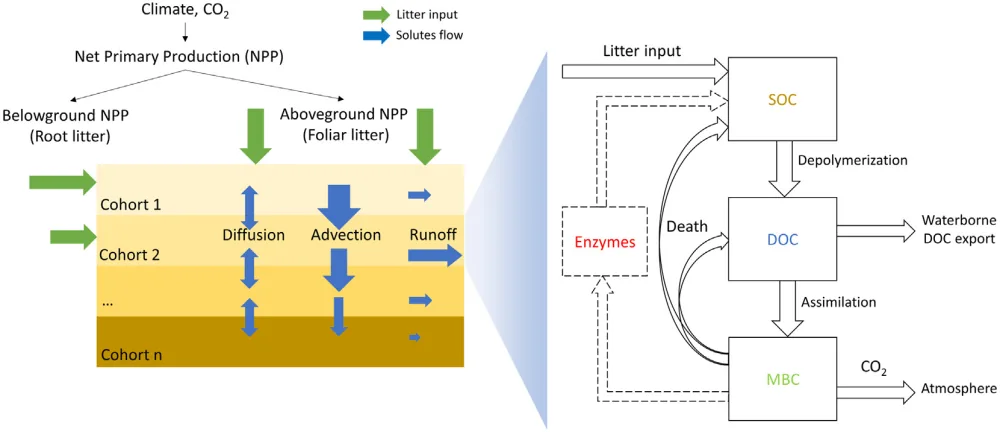
Peat cohort tracking and microbial decomposition. From Shao et al. 2022, STOTEN
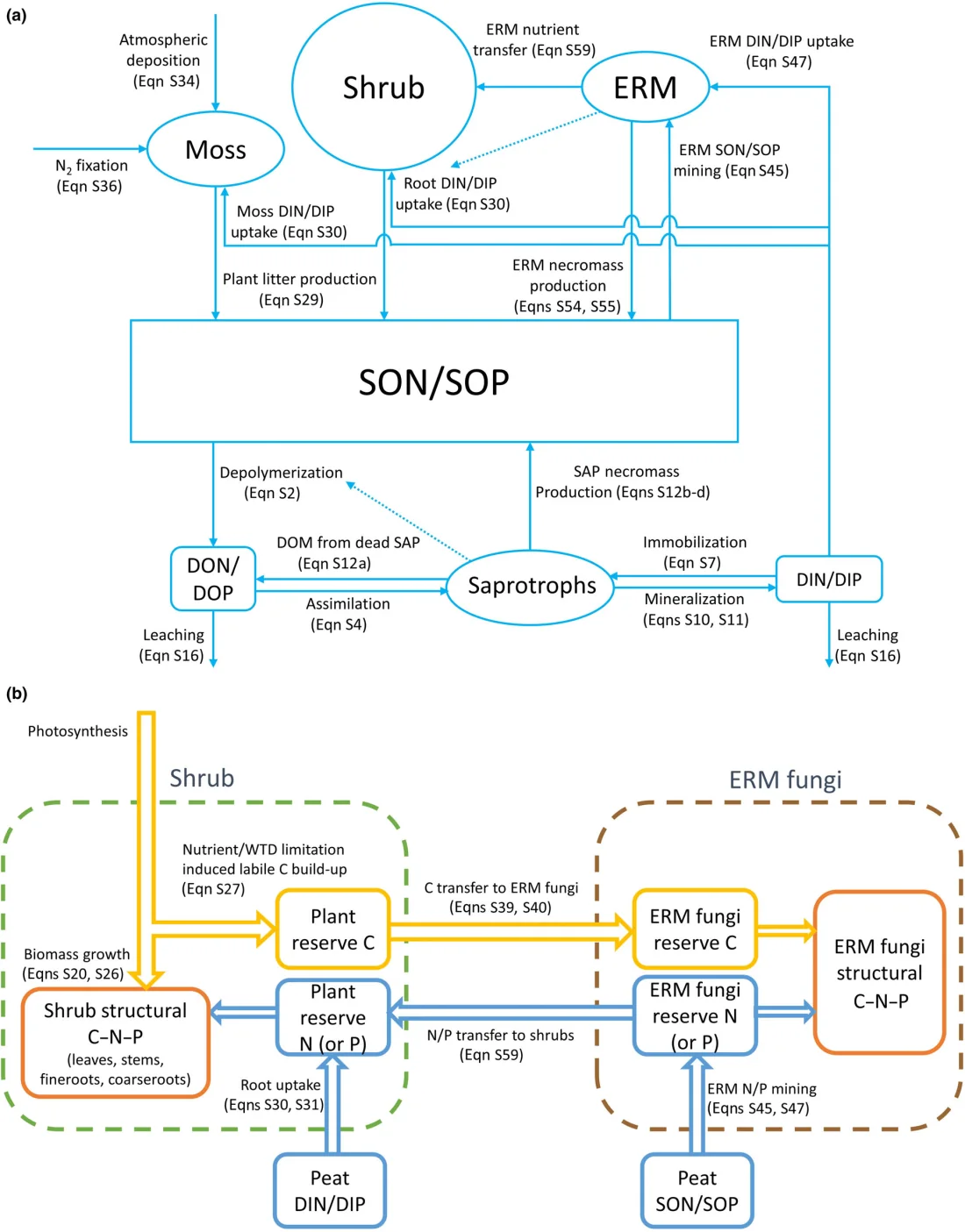
Nutrient cycling and the shrub–ericoid mycorrhizal exchange. From Shao et al. 2023, New Phytologist
Model website: mwmpeat.weebly.com
Applied in: peatland carbon and nutrient cycling — see Research
Myco-CORPSE
An extension of the CORPSE soil carbon model that represents mycorrhizal functional diversity and the carbon cost of nitrogen acquisition in temperate forests, with explicit ectomycorrhizal and arbuscular mycorrhizal pools.
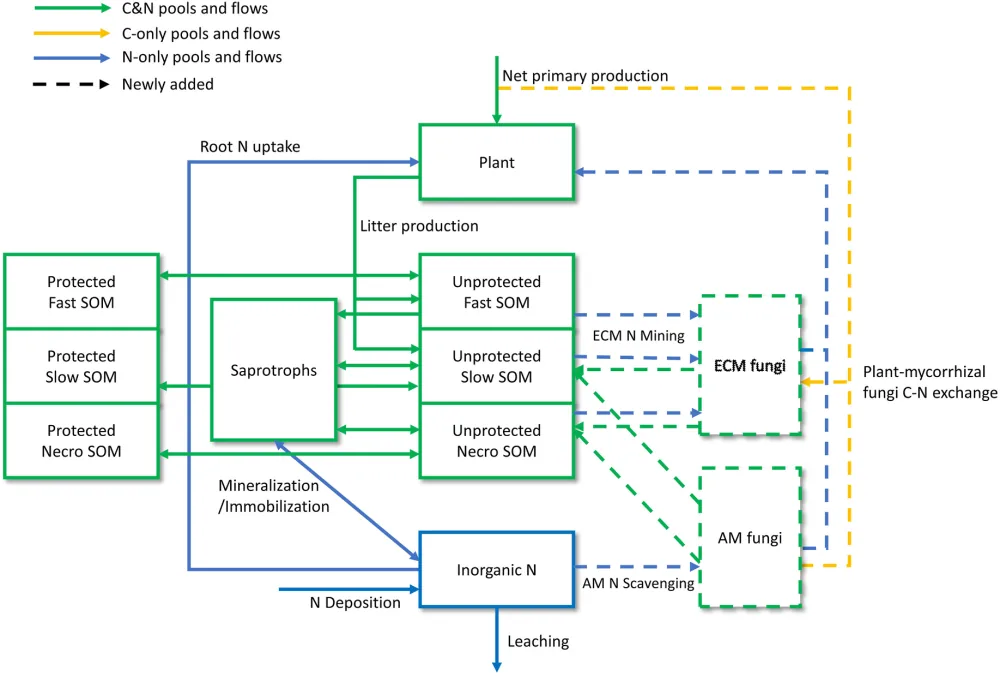
Model structure, with the mycorrhizal pools added to CORPSE. From Shao et al. 2023, SBB
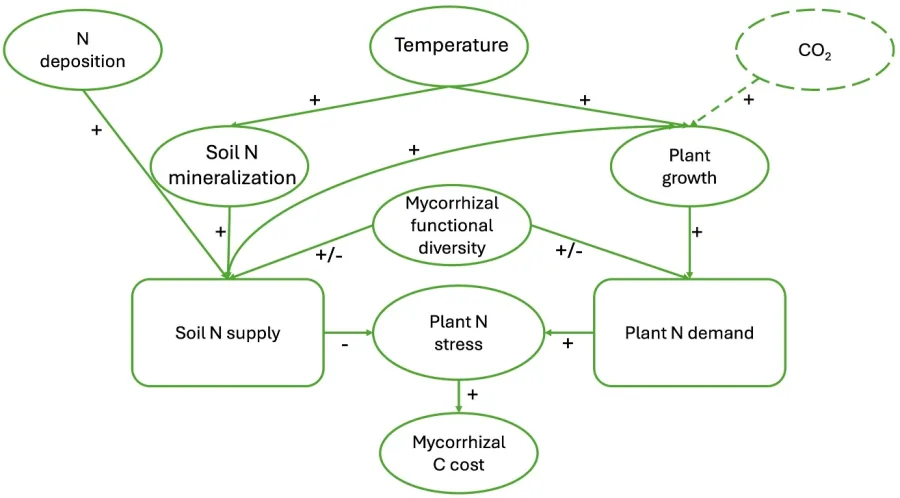
Drivers of mycorrhizal carbon cost. From Shao et al. 2025, JGR: Biogeosciences
Applied in: mycorrhizal carbon economies in forests — see Research
ecosys
A comprehensive process-based ecosystem model. We extended it with mineral dissolution kinetics so that enhanced rock weathering is simulated alongside, rather than separately from, plant and microbial activity.
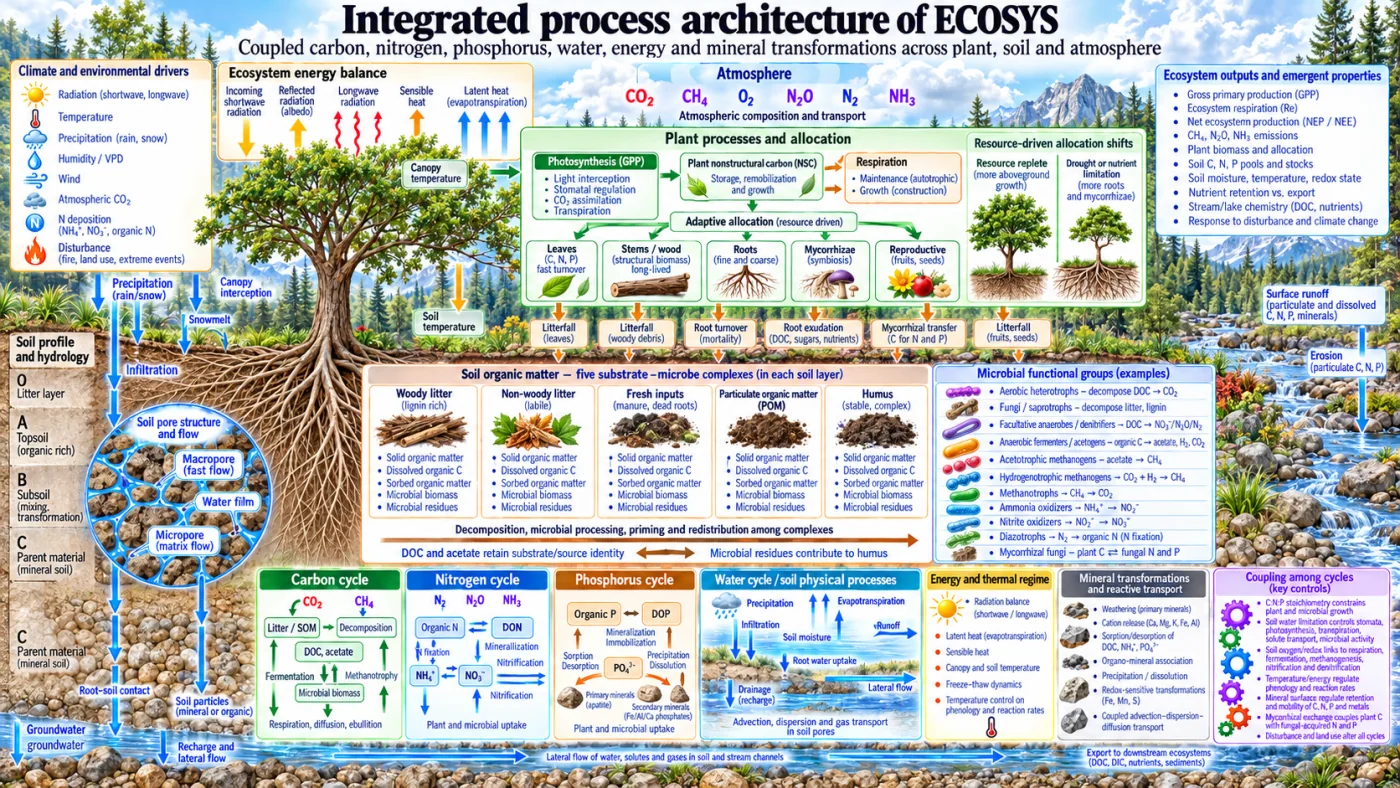
Integrated process architecture: coupled C, N, P, water, energy and mineral transformations across plant, soil and atmosphere
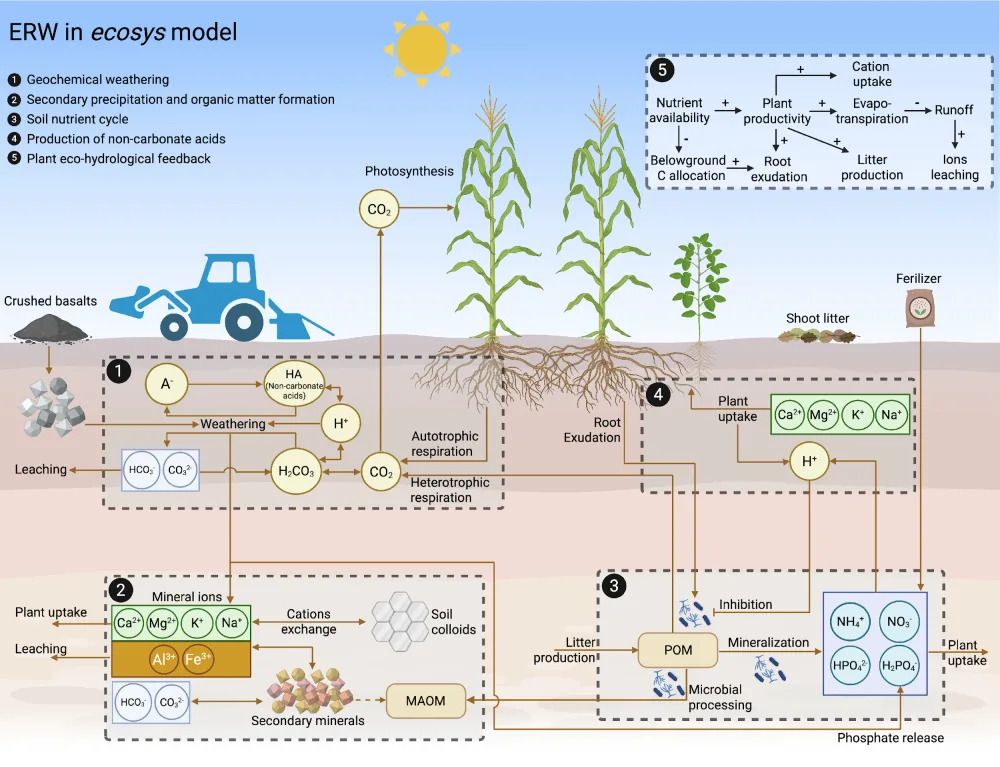
Coupled weathering, nutrient and plant processes as implemented in ecosys
Source code: github
Applied in: enhanced rock weathering and soil carbon removal — see Research
- Shao, S., Wu, J., He, H., & Roulet, N. (2022). Integrating McGill Wetland Model (MWM) with peat cohort tracking and microbial controls. Science of The Total Environment, 806, 151223. 10.1016/j.scitotenv.2021.151223
- Shao, S., Wu, J., He, H., Moore, T. R., Bubier, J., Larmola, T., Juutinen, S., & Roulet, N. T. (2022). Ericoid mycorrhizal fungi mediate the response of ombrotrophic peatlands to fertilization: a modeling study. New Phytologist, 238(1), 80–95. 10.1111/nph.18555
- Shao, S., Wurzburger, N., Sulman, B., & Hicks Pries, C. (2023). Ectomycorrhizal effects on decomposition are highly dependent on fungal traits, climate, and litter properties: A model-based assessment. Soil Biology and Biochemistry, 184, 109073. 10.1016/j.soilbio.2023.109073
- Shao, S., Shortt, Z., Sulman, B., & Hicks Pries, C. (2025). Modeling Mycorrhizal Carbon Costs in Temperate Forests: The Impacts of Functional Diversity and Global Change Factors. Journal of Geophysical Research: Biogeosciences, 130(10). 10.1029/2025jg009198